
AI Search
He Didn't Google Us. He Asked His AI Agent, and It Found Us.
Yesterday someone I had never met stood up in a room full of people and told everyone how he found us. He did not Google it. He asked his AI agent to find him an interesting event in Austin. The agent found ours, booked it, and added it to his calendar. Then he walked into Google's building at the Sail Tower to hear me talk about AI SEO.
I have given a lot of talks. I am not sure I have ever had better proof of the exact thing I came to say.
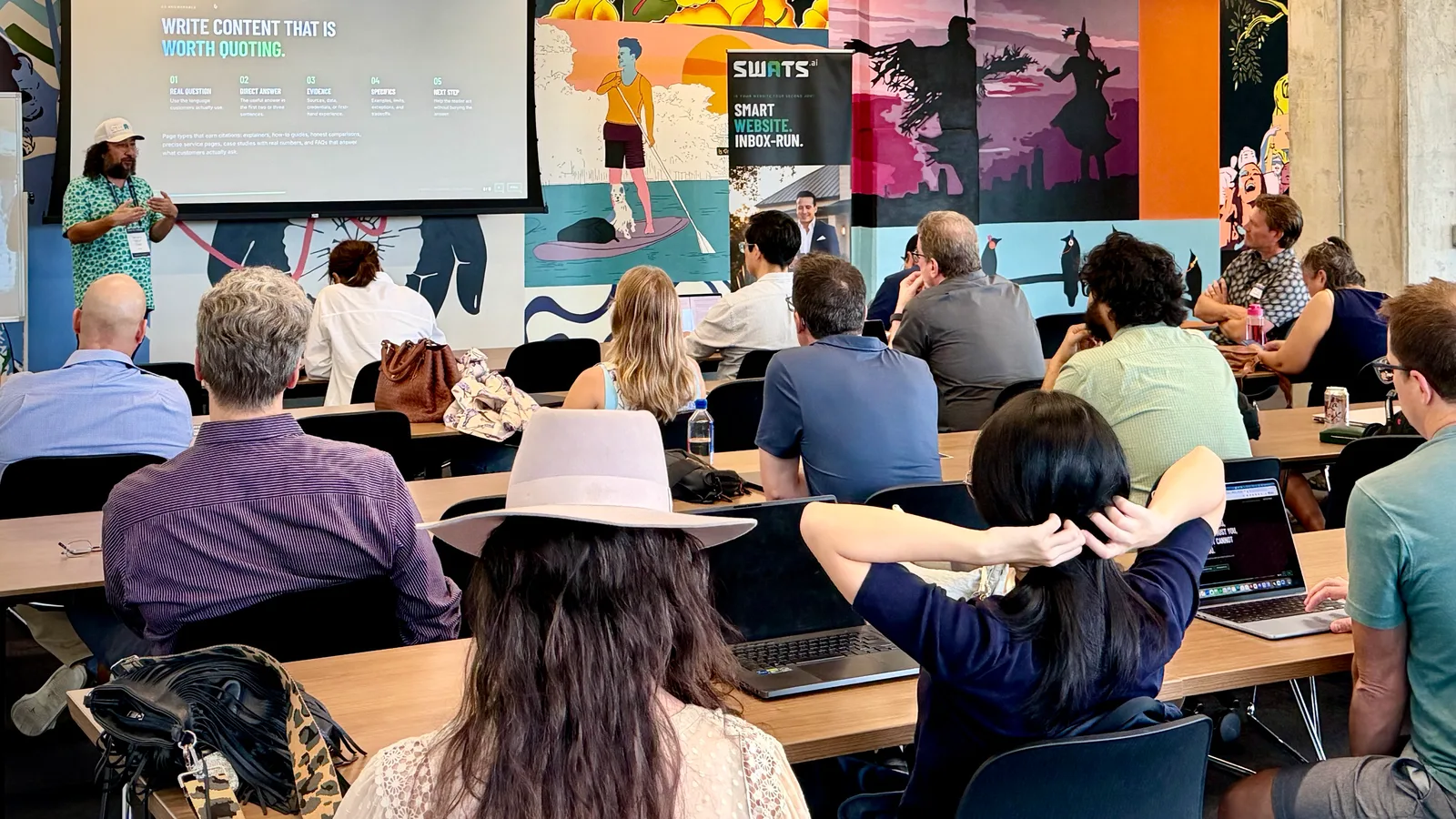
A stranger told the room how he found us
Think about what did not happen. He did not open a search engine and scan a page of links. He did not scroll an events site, compare listings, read descriptions, and decide. He did not click an ad. He handed the whole job to an assistant: find me something interesting in Austin, make sure it fits, book it, and put it on my calendar. The first time a human was in the loop was when he showed up at the door.
For our event to be the one the agent picked, the agent had to be able to find it, read it, and judge it worth his evening, all without a person double-checking its work. It did. That is the whole story, and it is a bigger story than one event.
People are handing discovery to their agents
For years the question was whether your website showed up on a page of blue links that a person would then scan with their own eyes. A growing number of people never see that page anymore. They ask an assistant to do the finding for them, and they trust the short answer it brings back.
That is the shift, and it only moves in one direction. Discovery is turning from something people do into something people delegate. When that happens, the audience you are trying to win is not only the human. It is the agent the human sent ahead. People are handing discovery to their agents, and the agent decides who makes the short list before your future customer ever lays eyes on you.
Find and trust, or you are not on the list
Two words carry all the weight here: find and trust. An agent has to be able to find your site, which means it can actually read it: the page is fast, it is crawlable, and the real content lives in the HTML instead of appearing only after a pile of scripts finishes running. And it has to be able to trust what it reads, which means your answers are clear, current, specific, and consistent with what the rest of the web says about you.
If either half fails, you are quietly left off the list, and nobody sends you a rejection notice. You just never get the booking, the call, or the visit, and you never find out why. I wrote about the mechanics of this in why ChatGPT can't find your website. Yesterday I watched it decide in real life, in my favor, in front of a full room. I could not have asked for better proof. If an AI cannot find and trust your website, you are not on the list.
What we built with The Austin Forum
Thank you to The Austin Forum on Technology & Society for hosting, and to the full room for showing up. We are proud to have built the new Austin Forum Smart Website with SWATS: designed for people, readable by AI, and updated by email.
Those three are not slogans, they are the job. Designed for people means it is clear and fast for a human who lands on it. Readable by AI means an agent can fetch it, parse it, and quote it without guessing. Updated by email means it never goes stale, because keeping it current does not require anyone to log into a dashboard. A site that stays alive is exactly what an agent rewards when it decides who is worth recommending.
Where SWATS comes in
Here is the honest part. All of this is simple to understand and genuinely tedious to maintain. Staying fast, staying readable, and staying current as your business changes is real, ongoing work, and it is exactly the work most websites quietly stop doing a month after launch. By then the agents have already moved on.
That is the whole point of SWATS. You pitch us your business once, we build a site that is clean for people and readable by machines, and after that keeping it current is as simple as sending an email. New service, new price, a new event, a question customers keep asking? Email it. We build the change, you approve a preview link, and it goes live. The site stays alive, which is exactly what AI-driven discovery rewards.
Want to know whether an agent can find and trust your site right now? Run the free SWATS Scorecard and see if you are visible, or invisible, to AI search.
This is the way. 🤖
— Jenaro Diaz, Founder & CEO, SWATS
Want to know where your site actually stands?
Run the free SWATS Scorecard and see if your site is visible, or invisible, to AI search.
Source: Remarks at The Austin Forum on Technology & Society, Austin, TX, and SWATS AI project experience, 2026.